 RuneCake
From your first 100k to end-game bossing — in both Old School and RuneScape 3. Pick a method that fits your levels, your playtime, and how much attention you want to give.
This free Old School RuneScape money making guide covers beginner GP methods, mid-game money makers, high-level bossing and AFK options. Use the filters below to compare requirements, GP per hour and effort, then pick the best OSRS money making method for your account.

Plant herbs in all available patches, use ultracompost, and harvest every 80 minutes. Ranarr and snapdragon are the classic profit picks; torstol is strong at higher Farming.
Why it works: the run takes about 5–6 minutes, so a full hour of efficient runs stacks multiple harvests. It also fits around any other activity.

Set up four birdhouses on Fossil Island, then check them roughly every 50 minutes. Seeds and nests add up fast, and the run takes under three minutes.
Tip: pair birdhouses with a herb run for a very profitable 10-minute loop.

Smelt steel or mithril bars at the Blast Furnace. Buy ore, use coal, and bank the bars. Ice gloves and stamina potions keep the cycle smooth.
Requires: Smithing 30+ for steel, 50+ for mithril, and the Forgotten Curse quest for the Blast Furnace.
Buy logs, run them through the sawmill, and sell the planks. Oak and teak planks are the usual staples. Zero combat requirements and very low risk.

Run the six Barrows brothers, loot the chest, and teleport out. Ahrim's and Karil's pieces carry most of the value, with a rare chance at an expensive item.
Setup: Magic 50+ for Iban Blast or better, a salve amulet, and a fast teleport out. Kill count affects rune drops; 6–10 kills is a good balance.

Learn the rotation, bring both combat styles, and stack kills. Scales, magic fangs, and the rare Tanzanite fang make it one of the best solo bosses for your time.
Tip: don't chase perfect gear. A trident, blowpipe, and good switches will get you profitable kills.

Kill rune dragons for dragon metal, rune items, and the rare draconic visage. Use dragon hunter lance or crossbow and protect from melee.

The benchmark boss for consistent money. With a dragon hunter crossbow or lance and good mechanics, kills take around two minutes and drop valuable bones, hides, and uniques.
Requirements: Dragon Slayer II, high Ranged or Melee, and a solid supply of antifire and food.

Group raids have the highest ceiling in the game thanks to twisted bows, scythes, and tumeken's shadows. Even without a unique, regular loot and raid supplies pay well.
Tip: join a clan or a raid discord. Consistent teams clear faster and split uniques fairly.

Take boss tasks from Duradel or Konar. Alchemical Hydra, Cerberus, Kraken, and Thermonuclear Smoke Devil all turn a slayer task into reliable profit while training Slayer.
Fishing is the classic AFK money maker. Anglerfish need 82 Fishing; sacred eels need 87 and give scales. Perfect for working or watching something else.
Mine amethyst in the Mining Guild for crystal-shard-ready ore. It is extremely AFK, needs 92 Mining, and pairs well with varrock armour and a celestial ring.

Buy low, sell high, and track margins on high-volume items. Focus on items with steady demand: supplies, popular gear, and skilling materials. Never flip an item you don't understand.
Tip: start with 1–5M, learn one market at a time, and keep a portion of your bank liquid.

Skilling bosses with low entry requirements. Wintertodt needs 50 Firemaking; Tempoross needs 35 Fishing and 35 Cooking. Rewards include supplies, seed packs, and fish.

Mine pay-dirt, clean it at the hopper, and bank the ores. Not the fastest GP, but it trains Mining well and is extremely relaxed.
Prefer RuneScape 3? These RS3 money makers are priced in RS3 GP, not site credits. RuneScape 3 gold trades at a different rate to OSRS gold — see our OSRS ⇄ RS3 swaps page for the live rate. Already have RS3 GP? You can swap it for OSRS GP there, or use the Quick Sell options on the marketplace.
Buy low and sell high on the RS3 Grand Exchange. Track margins on high-volume items — food, runes and consumables move fastest — and keep your offers undercutting the current guide price.
Requires: A little starting capital and patience. No quests or combat skills needed.
Plant high-level seeds such as torstol or dwarf weed in the many RS3 herb patches, then teleport between them. Use a seed dicer and the right compost to protect your crops.
Requires: Farming level for your chosen seed and completed patches. Magic or portable teleports keep routes quick.
RS3 Slayer rewards scale sharply with your task streak. Focus on high-value creatures, use a reputable slayer helmet and sell the rare drops and stacks you bank.
Requires: Combat gear appropriate to your level and access to a Slayer master. Higher tiers need quests and better equipment.
Group bossing at Araxxor, Telos, the Elite Dungeons and Raids pays out in valuable drops. RS3 gear requirements are steep, but the GP per hour is among the best in the game.
Requires: High combat stats, augmentable gear and learned mechanics. Join a learning clan if you are new to a boss.
Catch and cook high-tier fish at a calm spot. It is a relaxed way to bank GP while watching something else, and the cooked fish sell steadily on the Grand Exchange.
Requires: Fishing and Cooking levels for your chosen fish. A portable cooking range or nearby bank speeds things up.
RS3 GP figures are indicative ranges and vary with the live Grand Exchange. Want OSRS gold instead? Swap at the live 1:14 OSRS ⇄ RS3 rate with no service fee.
Pick a method from the list above, set how long you play each day, and see how long your target will take. The rate comes from the GP/hour range published for that method.
Estimates use the midpoint of the published range for time and the low/high ends for the range. Gear, levels, competition and attention change real GP/hour, so treat this as a planning tool, not a promise. Prefer to skip the grind? Browse live OSRS GP listings.
Plank making and low-level fishing need no quests or combat, so they are the easiest starting points. Add herb runs and birdhouse runs as soon as you can — both take a few minutes and pay well for the time invested.
Methods such as Barrows, Rune Dragons and Blast Furnace normally land between 800k and 3M GP per hour. Your real result depends on levels, gear, supply costs and how consistently you run the method.
No. Grand Exchange prices move daily and every account is different. The ranges on this page are realistic planning figures, not promises — check current prices before committing to a grind.
Anglerfish and sacred eels, amethyst mining and the Motherlode Mine are the most relaxed options. Amethyst needs 92 Mining, while the Motherlode Mine is available from 30 Mining.
Most of the higher-paying methods, including herb runs, birdhouses, Barrows, Zulrah, Vorkath and raids, require a members account. Free-to-play players can still start with planks, low-level fishing and the Grand Exchange.
This guide is educational. Exchanging OSRS gold for real money is against Jagex terms of service, so check their current rules before trading and understand the risks involved.
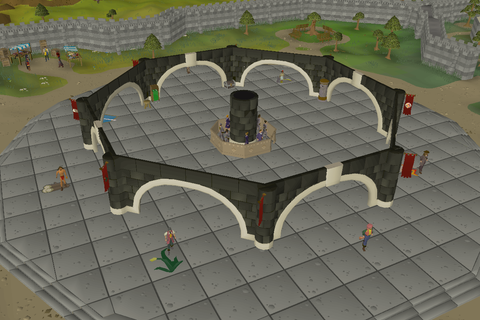 Grand Exchange
 Slayer icon
 Attack skill
 Quest icon
Images: Old School RuneScape Wiki / Jagex Ltd., CC BY-NC-SA 3.0.
